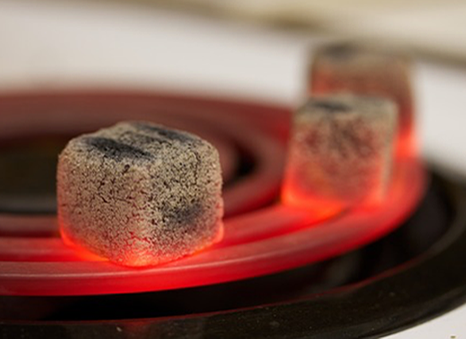
The two most common hookah charcoal types are coconut and quick-light (self-igniting). They solve different problems. Here’s the difference so you can choose for the situation.
Quick-light charcoal
Lights from a lighter in seconds thanks to chemical additives (usually saltpetre). The one upside is speed and convenience — outdoors, camping, no stove needed.
Downsides for hookah:
- Chemical aftertaste — additives add a foreign smell and spoil the tobacco flavour.
- Short burn — burns out fast, the bowl is unstable.
- More ash and a harsh smell when lighting.
It’s a last-resort charcoal, not one for a quality session.
Coconut charcoal
Made from coconut shell with no chemical accelerants. It lights on a stove or burner in 5–10 minutes, but delivers:
- Clean flavour — doesn’t override the tobacco.
- Long, even heat — a predictable session.
- Minimal ash and no foreign smell.
That’s why lounges and enthusiasts run on coconut.
Comparison
| Criterion | Coconut | Quick-light |
|---|---|---|
| Flavour | Clean | Chemical aftertaste |
| Burn time | Long, even | Short |
| Lighting | Stove/burner, 5–10 min | Lighter, seconds |
| Ash | Minimal | High |
| For a venue | Yes | No |
Verdict
For the outdoors, quick-light will do. But for a venue, retail, and anyone who values flavour, the choice is clear — coconut charcoal. The difference in taste and stability is worth the extra minutes to light.
Need premium coconut charcoal wholesale? Contact us — we’ll send prices and an IZZY COCO sample.